
Play Chicken Road Now!
Home → strategy
Chicken Road Strategy
Approaching Chicken Road sensibly
Chicken Road, developed by InOut Games, is an instant-win crash game released in 2024. It features a unique step-based road-crossing mechanic where a chicken advances, increasing the multiplier until it's potentially hit. The game's theoretical return to player (RTP) stands at a notable 98.00%, indicating a house edge of 2.00% over an extended period of play. This RTP is higher than that of Fish Road, which offers 96.00%.
The core gameplay loop in Chicken Road involves players deciding when to cash out before the chicken meets its demise, thereby securing their accumulated multiplier. This mechanic differs significantly from traditional slot machines, which rely on spinning reels and symbol combinations. The maximum win potential in Chicken Road is an impressive x3,608,855, far exceeding the x2,542,251.93 maximum win offered by Fish Road.
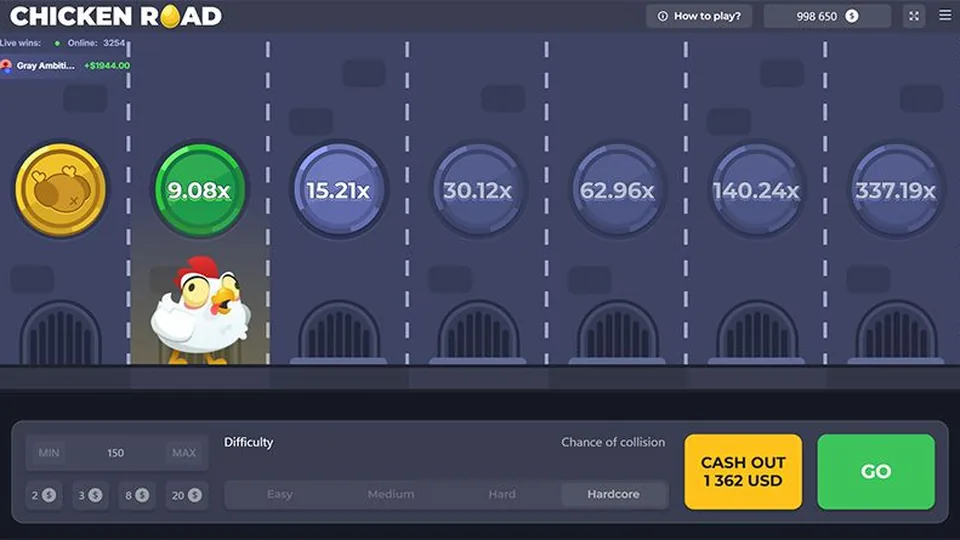
Players can engage with Chicken Road across four distinct difficulty levels: Easy, Medium, Hard, and Hardcore. Each level adjusts the number of lanes the chicken must cross and the curve of the multiplier's ascent, offering varied risk-reward profiles. The game also incorporates provably fair technology using SHA-256 server and seed verification, ensuring transparency and trust for players.
Bankroll rules that hold up
Managing your bankroll effectively is crucial when playing Chicken Road, especially considering its maximum win potential of x3,608,855. The game allows for bets ranging from $1 to $7 per round, a relatively narrow band that can help players maintain control. This controlled bet range contrasts with some other instant games that might offer wider betting options.
The theoretical return to player (RTP) for Chicken Road is 98.00%, meaning that for every $100 wagered over a very long run, $98 is theoretically returned to players. This figure is a critical component in long-term bankroll planning. Understanding this RTP is key to setting realistic expectations for your gaming sessions.
For players looking to compare, Fish Road, another InOut Games title, has a stated RTP of 96.00%. While both are instant games, the higher RTP of Chicken Road suggests a slightly more favourable long-term outlook for players, assuming consistent gameplay and luck. This difference can influence how much of a player's bankroll is theoretically preserved.
Bet sizing against volatility
Chicken Road offers a bet range from $1 to $7, providing a controlled environment for players to manage their wagers against the game's inherent volatility. The game's multiplier increases as the chicken advances, and the player must decide when to cash out. The maximum win is a substantial x3,608,855.
The game's volatility is influenced by the chosen difficulty level, with Hardcore presenting the highest risk and potentially the steepest multiplier climb. This contrasts with games that have fixed paylines and symbol combinations, where volatility is often dictated by symbol frequency and payout values. Chicken Road's dynamic multiplier system offers a different kind of risk.
Compared to titles like Fish Road, which has a maximum win of x2,542,251.93, Chicken Road presents a significantly higher ceiling. This increased potential can attract players seeking larger payouts, but it also implies that achieving those top wins may require navigating more challenging multiplier curves and higher risk levels within the game's mechanics.
Session limits worth setting
Establishing session limits is a responsible approach when engaging with Chicken Road, particularly given its potential for rapid gameplay and its maximum win of x3,608,855. The game's instant-win format, driven by a rising multiplier, can lead to quick rounds. Setting a time limit or a loss limit is advisable for maintaining control.
The theoretical return to player (RTP) for Chicken Road is 98.00%. This figure suggests that over an extended period, the house edge is 2.00%. While this RTP is favourable, it does not guarantee wins within a single session, reinforcing the importance of defined session boundaries to prevent overspending.
For context, Fish Road has an RTP of 96.00%. The higher RTP of Chicken Road might encourage longer play, making session limits even more critical. The game's difficulty levels also allow players to adjust the intensity, but even on Easy, the multiplier mechanics necessitate disciplined play and adherence to set limits.
Why chasing losses fails
The strategy of chasing losses by increasing bets after a losing round in Chicken Road is a fallacy. With a fixed bet range of $1 to $7 and a maximum win of x3,608,855, progressively increasing stakes does not alter the game's fundamental 98.00% RTP. The house edge remains constant, meaning larger bets only expedite potential losses.
The core mechanic of Chicken Road involves cashing out before the chicken is hit, with multipliers climbing as the chicken advances lane by lane. This instant-win nature, coupled with the provably fair SHA-256 technology, ensures game integrity. However, it doesn't provide any advantage to players attempting to recover previous losses through increased betting.
Unlike games with progressive jackpots or fluctuating bonus features where strategy might seem applicable, Chicken Road's structure is consistent. Attempting to chase losses here, perhaps by playing on higher difficulty levels after a loss, is simply increasing exposure to the 2.00% house edge without any guaranteed return, as demonstrated by the fixed RTP across all rounds.
Chicken Road: key facts
| Parameter | Value |
|---|---|
| Game | Chicken Road |
| Studio | InOut Games |
| Released | 2024 |
| RTP | 98.00% |
| House edge | 2.00% |
| Max win | x3,608,855 |
| Bet range | $1 – $7 |
Common systems and their limits
Chicken Road, a crash game by InOut Games, allows stakes ranging from $1 to $7 per round. This narrow bet range is consistent with many instant-win titles designed for quick play sessions. Other crash games might offer broader betting windows, but Chicken Road focuses on accessibility for casual players.
The maximum multiplier in Chicken Road can reach an impressive x3,608,855. This contrasts with titles like Rabbit Road, which shares the same maximum win potential from the same developer. Players should be aware that achieving such high multipliers is extremely rare and depends on successfully cashing out at the right moment.
With a theoretical RTP of 98.00%, Chicken Road offers a favorable return to player over the long term. This figure indicates a house edge of 2.00%, which is competitive within the instant-win market. Some slot games, by comparison, may have lower RTP percentages, impacting their long-term profitability.
Flat betting explained
Flat betting involves placing the same stake on every single round of Chicken Road, regardless of previous outcomes. For instance, a player might consistently bet $5 on each attempt to cross the road. This disciplined approach helps manage bankroll by maintaining a predictable expenditure per round.
Using a flat bet of $5 on Chicken Road means each round incurs this cost, irrespective of whether the chicken is hit or successfully crosses. This contrasts with variable staking strategies, where the bet amount changes based on wins or losses. The game's fixed bet range from $1 to $7 accommodates this strategy.
The consistency of flat betting in Chicken Road ensures that the house edge of 2.00% applies uniformly to every wager. While this strategy does not alter the game's mathematical probabilities, it offers a straightforward method for players to track their spending. Other crash games might offer different RTPs, but the betting approach remains key.
Progressive staking risks
Progressive staking, also known as progressive betting, involves increasing your bet size after each loss in Chicken Road. For example, a player might start with a $1 bet and increase it after a loss, aiming to recoup previous stakes with a subsequent win. This strategy does not alter the game's inherent probabilities.
The significant risk with progressive staking in Chicken Road is the potential for rapid bankroll depletion. A string of consecutive losses, which are possible in any crash game, can quickly escalate bet amounts beyond affordable limits. This can lead to a premature end to play sessions, even with a high RTP of 98.00%.
While some players might explore progressive staking in Chicken Road, it is crucial to understand that it does not overcome the house edge. This method can accelerate the rate at which funds are lost compared to flat betting. In contrast, titles like Rabbit Road, with its 95.50% RTP, present a steeper challenge when using such strategies.
What the maths actually allows
The mathematics of Chicken Road, with its 98.00% RTP, fundamentally means that for every $100 wagered over an extensive period, players can theoretically expect to get $98 back. The remaining $2 represents the house edge, a consistent advantage for the casino. This percentage is calculated over millions of potential rounds.
Players can aim for the maximum win of x3,608,855 in Chicken Road, but the mathematical probability of hitting this figure is extremely low. The game's step-based multiplier progression and the risk of the chicken being hit mean that successful cash-outs are essential. The provably fair SHA-256 verification adds transparency to each round's outcome.
The four difficulty levels in Chicken Road (Easy, Medium, Hard, Hardcore) adjust the lane count and multiplier curve, influencing the risk-reward balance. While these settings alter the immediate player experience, they do not change the overall 98.00% RTP. This contrasts with some slot games where bonus features might have different payout structures.
Reading variance honestly
Variance in Chicken Road refers to the natural fluctuation of outcomes; players might experience streaks of wins followed by periods of losses. Despite the high 98.00% RTP, short-term results can deviate significantly from this theoretical average. This unpredictability is inherent in all casino games, including crash titles like Chicken Road.
Understanding variance means accepting that even with a favorable RTP, a player's session may not yield the expected 98% return. Small bankrolls are particularly susceptible to the swings of variance, potentially leading to quicker depletion. This is a key consideration when choosing bet sizes within the $1 to $7 range offered by Chicken Road.
The maximum win of x3,608,855 in Chicken Road represents an extreme end of the variance spectrum. Achieving such a multiplier requires successfully navigating multiple steps without the chicken being caught. While rare, these massive potential wins are what can make highly volatile games like Chicken Road appealing to some players, even with the risks.
Learning the game in demo first
Before engaging with real money, understanding the mechanics of Chicken Road is advisable. This crash game by InOut Games features a unique step-based road-crossing progression where the multiplier climbs as a chicken advances lanes. Players must strategically decide when to cash out before the chicken is hit, a core element absent in traditional slot games which rely on spinning reels.
The game offers four distinct difficulty levels: Easy, Medium, Hard, and Hardcore, each adjusting the lane count and the multiplier curve to alter the player experience. This variety in challenge can be explored in demo mode, allowing players to become familiar with the payout structure and the risks associated with each level. Chicken Road's maximum win potential stands at an impressive x3,608,855.
Compared to titles like Chicken Road 2, which has a lower RTP of 95.50%, Chicken Road boasts a theoretical return to player of 98.00%. Testing these differences in a demo environment can highlight the impact of RTP on long-term play, even before any bankroll is committed to the game by InOut Games.
Adjusting stakes to your budget
Chicken Road allows for a flexible bet range, accommodating players with stakes from $1 to $7 per round. This broad spectrum ensures that individuals managing different bankroll sizes can participate in the game. The core gameplay loop, a rising multiplier before the chicken is hit, remains consistent across all bet levels, providing a uniform experience regardless of stake.
For players aiming to extend their playtime, employing a flat betting strategy where the same stake is placed each round is a common approach. This contrasts with progressive staking, which can accelerate bankroll depletion without altering the game's inherent 2.00% house edge. Chicken Road's maximum win of x3,608,855 is achievable at any bet level, though the actual payout will be proportional to the wager placed.
The theoretical return to player for Chicken Road is set at 98.00%, a figure that represents long-term averages over extensive play. This percentage is higher than some other crash games, offering a potentially more favourable environment for players. Understanding this RTP is crucial when setting stakes, as it informs the expected return over a prolonged gaming session.
Recognising a bad session
A 'bad session' in Chicken Road can be identified by a sustained period of losses that significantly deplete a player's bankroll. This can occur even with the game's high RTP of 98.00%, as this figure reflects theoretical long-term outcomes, not guaranteed results in short play. The step-based road-crossing mechanic, where the multiplier climbs before the chicken is potentially hit, means outcomes can be volatile.
Recognizing the signs of a losing streak, such as consecutive failed cash-outs or a rapid decrease in available funds, is vital for maintaining control. While Chicken Road offers a maximum win of x3,608,855, the path to such a prize is not guaranteed and can involve periods of low returns or losses. The game's four difficulty levels can also influence the frequency and magnitude of wins and losses.
Unlike traditional slot machines where volatility might be categorized, Chicken Road's difficulty settings inherently adjust the risk-reward dynamic. A Hardcore setting, for instance, will present a more aggressive multiplier curve and potentially shorter windows for cashing out, increasing the likelihood of rapid bankroll changes. Players should be mindful of these variations when assessing their session's performance.
Stopping while ahead
The principle of 'stopping while ahead' is particularly relevant in crash games like Chicken Road, where a rising multiplier offers a clear opportunity to secure profits. Players must establish a target profit level or a win threshold and adhere to it, even when the game appears to be on a favourable streak. Chicken Road, developed by InOut Games, features a maximum win of x3,608,855, but reaching this is exceptional.
Setting a clear objective, such as cashing out after achieving a 50% profit on the session's starting bankroll, can prevent players from losing accumulated gains. This disciplined approach is crucial given Chicken Road's 98.00% RTP, which suggests that over extended periods, the house edge of 2.00% will gradually influence outcomes. The GO/cash-out mechanic is central to this strategy.
Deciding to stop when ahead is a personal strategy that complements the game's design. For instance, if a player has achieved a significant multiplier boost on a single round in Chicken Road, cashing out that win and concluding the session can be a wise move, securing the profit rather than risking it on subsequent rounds. This contrasts with the continuous play often associated with slot machines.
Responsible play in practice
Practicing responsible play with Chicken Road involves setting clear limits on both time and money before commencing any gaming session. This includes defining a strict budget for losses and a target for wins, ensuring that play remains within affordable means. The game, featuring a bet range from $1 to $7, allows for adaptable budgeting, but discipline is paramount.
For players utilizing the 300% welcome bonus, understanding the wagering requirements associated with it is a critical component of responsible play. For example, a 300% bonus on a $100 deposit would amount to a $300 bonus, requiring substantial turnover before it can be withdrawn. Chicken Road's RTP of 98.00% should be considered alongside these bonus terms.
Self-exclusion tools and session timers are practical features that can aid in responsible gaming when playing Chicken Road. These mechanisms help enforce pre-determined limits, preventing impulsive decisions and ensuring that gaming remains a form of entertainment rather than a compulsion. The provably fair nature of Chicken Road, via SHA-256 verification, also provides transparency in its outcomes.
DemoRTP & VolatilityHow to PlayAuto CashoutStrategyBonusesMobileDownload & AppMax WinSimilar GamesReviewFAQSitemap
Chicken Road 2026