
Play Chicken Road Now!
Home → auto-cashout
Chicken Road Auto Cashout
Auto cashout in Chicken Road
Chicken Road, an instant game by InOut Games released in 2024, offers an auto cashout feature allowing players to pre-set their exit multiplier. This function automates the stopping point of a round, removing the need for manual intervention. The game's maximum win potential stands at x3,608,855, highlighting the significant multipliers achievable.
Chicken Road round parameters
| Max multiplier | x3,608,855 |
| RTP | 98.00% |
| Bet range | $1 - $7 |
With a bet range from $1 to $7, the auto cashout feature in Chicken Road can be strategically employed across various stakes. Unlike games with fixed paylines, Chicken Road's multiplier climbs based on the chicken's progress along a path. The theoretical RTP for Chicken Road is 98.00%, indicating a low house edge of 2.00% over extensive play.
Implementing auto cashout can prevent impulsive decisions in Chicken Road, especially during high-stakes rounds. This contrasts with the manual play required in traditional slot games, where a 'spin' outcome dictates potential wins. Auto cashout ensures that a predetermined target multiplier is met or surpassed before the round concludes.
Setting a target multiplier
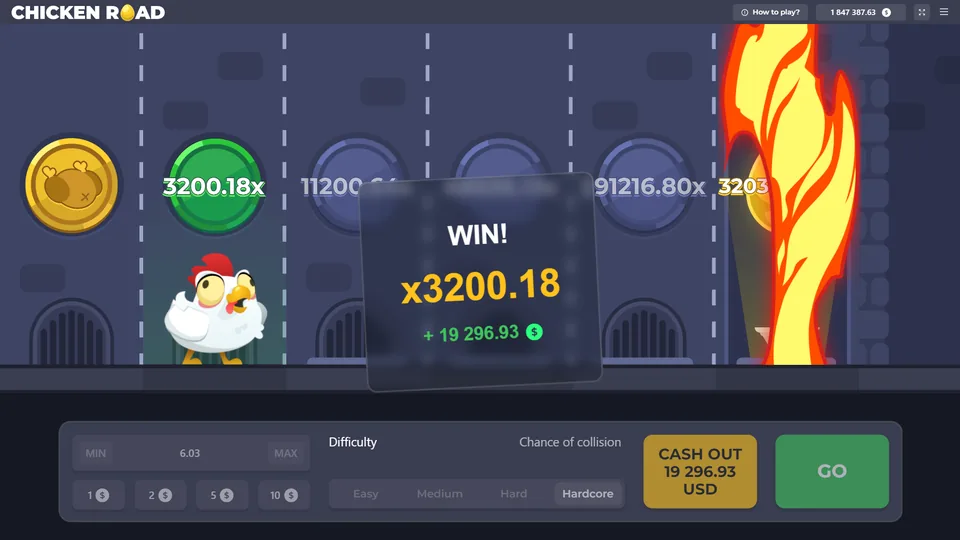
Chicken Road allows players to set a specific target multiplier, a critical element in managing risk and potential rewards. This game, developed by InOut Games, features a step-based multiplier progression as the chicken advances. Players must decide when to 'cash out' before the chicken is intercepted, with a maximum win of x3,608,855 available.
The four difficulty levels in Chicken Road (Easy, Medium, Hard, Hardcore) influence both the lane count and the multiplier curve, affecting the achievable target multipliers. The RTP of 98.00% for Chicken Road means that for every $100 wagered over an extended period, $98 is theoretically returned to players.
Setting a modest target multiplier in Chicken Road can lead to more frequent, smaller wins, a strategy that differs from games like Fish Road, which has a maximum win of x2,542,251.93. Players can adjust their target multiplier based on their chosen difficulty level and risk tolerance.
Why automation removes hesitation
The auto cashout feature in Chicken Road, by InOut Games, effectively removes the human element of hesitation during gameplay. As the multiplier climbs in this step-based crash game, players often face a split-second decision to cash out or risk losing their bet. Chicken Road's design, with its rising multiplier, presents this challenge uniquely.
By pre-setting an auto cashout target, players bypass the psychological pressure of deciding in real-time, thereby eliminating hesitation. This automated approach can be particularly beneficial in Chicken Road, which boasts a high RTP of 98.00%. The game's maximum win potential is x3,608,855.
This automation is a key differentiator from manual play in other game types, where a player's nerve can dictate the outcome. In Chicken Road, the predetermined multiplier target ensures a consistent strategy, regardless of emotional responses. The bet range for Chicken Road is from $1 to $7.
Low targets versus high targets
Choosing between low and high target multipliers in Chicken Road presents distinct strategic implications for players. A low target, for instance, might aim for a multiplier of x1.5, leading to more frequent but smaller wins. Chicken Road, developed by InOut Games, offers a maximum win potential of x3,608,855.
Conversely, aiming for high targets, such as x5 or higher, in Chicken Road increases the potential payout per round but also raises the risk of the chicken being intercepted before the target is reached. The game's RTP is a theoretical 98.00%, meaning the house edge is 2.00%.
The decision between low and high targets in Chicken Road should align with the player's risk appetite and the selected difficulty level. A game like Fish Road, with its maximum win of x2,542,251.93, might appeal to players seeking different risk-reward profiles.
Auto bet alongside auto cashout
Chicken Road's functionality extends to allowing players to combine auto bet with auto cashout features for a fully automated gaming experience. Players can select a bet amount within the $1 to $7 range and then set their desired auto cashout multiplier. This combination streamlines gameplay significantly.
This dual automation in Chicken Road, an instant game by InOut Games, allows for continuous play without constant manual input. The theoretical RTP of 98.00% remains constant, irrespective of whether auto bet and auto cashout are utilized. The maximum win is an impressive x3,608,855.
By pre-configuring both the bet amount and the cashout point, players can engage with Chicken Road consistently, managing their bankroll and potential returns efficiently. This setup contrasts with the manual betting and cashing out required in many other casino game formats.
Chicken Road: key facts
| Parameter | Value |
|---|---|
| Game | Chicken Road |
| Studio | InOut Games |
| Released | 2024 |
| RTP | 98.00% |
| House edge | 2.00% |
| Max win | x3,608,855 |
| Bet range | $1 – $7 |
Choosing a cashout target
Chicken Road operates as a step-based crash game where the multiplier increases as the chicken advances, with players needing to cash out before the chicken is hit. The game, developed by InOut Games, offers a theoretical RTP of 98.00%, providing a house edge of 2.00% over extensive play. Unlike slot games which feature reels and spinning symbols, Chicken Road focuses on strategic timing.
The maximum win potential in Chicken Road is an impressive x3,608,855, a figure that matches the potential of other InOut Games titles such as Rabbit Road. Players can select from four distinct difficulty levels: Easy, Medium, Hard, and Hardcore, each influencing the lane count and the speed at which the multiplier curve ascends. This allows for a tailored risk-reward experience.
Betting in Chicken Road is flexible, ranging from $1 to $7 per round, fitting various player budgets. An auto cashout feature allows players to set a predetermined multiplier target, removing the need for real-time reaction and ensuring a bet closes automatically. This feature, while convenient, does not alter the inherent house edge of the game.
Frequency against payout size
The core mechanic of Chicken Road involves a rising multiplier that players must exit before a 'hit' occurs, making the decision of when to cash out paramount. With an RTP of 98.00%, the game theoretically returns 98.00% of wagers over the long term, contrasting with the 95.50% RTP offered by Rabbit Road. This higher RTP suggests a potentially more favorable return for players in Chicken Road.
The game's maximum win is substantial at x3,608,855, achievable by successfully navigating the escalating multiplier. The difficulty levels—Easy, Medium, Hard, and Hardcore—directly impact the multiplier curve, effectively controlling the frequency and potential size of payouts. Hardcore settings, for instance, are designed to present a more challenging path with potentially higher multipliers.
Players have the option to set their bets between $1 and $7 in Chicken Road, allowing for strategic management of funds based on their risk tolerance and desired payout size. The game's structure means that higher multiplier targets necessitate longer survival times for the chicken, inherently reducing payout frequency compared to lower targets. This creates a dynamic interplay between risk and reward.
Testing targets in demo
Chicken Road offers a step-based road-crossing gameplay where a chicken advances, increasing the multiplier until it is 'hit', at which point the round ends. The game provides four distinct difficulty levels, each with a unique multiplier curve and lane count, influencing gameplay strategy. This design contrasts with traditional slot games that rely on reels and symbol combinations.
Players can explore the effects of different cashout targets by testing Chicken Road in a demo mode before committing real funds. The game's theoretical RTP is 98.00%, offering a competitive edge for players. This allows for an experimental approach to identifying optimal cashout points across the various difficulty settings without financial risk.
The bet range for Chicken Road is from $1 to $7, providing flexibility for players to adjust their stakes during practice sessions. Understanding how different multiplier targets affect the frequency of wins and losses is crucial, especially when considering the game's maximum win potential of x3,608,855. Testing in demo mode helps in familiarizing oneself with these dynamics.
Adjusting after a losing streak
Chicken Road is a crash game where a rising multiplier requires players to cash out before the game's 'hit' event concludes the round. The game features four difficulty levels, each affecting the multiplier progression and the player's survival odds. Unlike slot machines, Chicken Road focuses on timing and risk assessment rather than reel spins.
When facing a losing streak in Chicken Road, players might consider adjusting their cashout targets to mitigate further losses or seek a swift recovery. The game's RTP is a fixed 98.00%, meaning that while short-term fluctuations are expected, the long-term edge remains constant. This theoretical return is a critical factor when deciding on game strategy.
The bet range in Chicken Road is set between $1 and $7, allowing players to adjust their stake size in response to a series of unsuccessful rounds. While the maximum win is a substantial x3,608,855, it is important to remember that achieving such a payout requires navigating the multiplier to its highest potential. Adjusting strategy might involve lowering bets or targeting lower multipliers temporarily.
When to turn automation off
Chicken Road is a crash game developed by InOut Games, featuring a chicken that advances lane by lane, increasing the multiplier as it progresses. Players must strategically cash out before the chicken is 'hit' to secure their winnings. This game mechanic differs significantly from traditional slot titles, which involve reels and spinning symbols.
The game offers a high theoretical RTP of 98.00%, with a maximum win potential of x3,608,855. While an auto cashout feature is available, turning it off allows players to exercise manual control over their exit strategy. This is particularly relevant for players who prefer to react dynamically to the climbing multiplier, especially in higher difficulty settings.
Automation in Chicken Road can be beneficial for players seeking consistency or those who wish to remove the element of human reaction time, especially in the Easy or Medium difficulty settings. However, for players aiming to push the multiplier to its limits or those who enjoy the thrill of manual timing, especially on Hard or Hardcore settings, turning the auto cashout off provides greater agency.
Double bet setups
Chicken Road allows for dual bet placements, a feature not commonly found in traditional slot machines. Each bet can range from $1 to $7, providing flexibility for different risk appetites. This setup enables players to manage their wagers across two independent rounds simultaneously. For instance, a player might place a $2 bet on one instance of Chicken Road and a $5 bet on another.
The theoretical return to player (RTP) for Chicken Road is set at 98.00%, indicating a house edge of 2.00% over extended play. In comparison, Chicken Road 2 offers a lower RTP of 95.50%. This difference in RTP means that, theoretically, Chicken Road retains a smaller portion of wagers over the long term compared to its successor.
By utilising two bet setups in Chicken Road, players can explore different difficulty levels or multiplier curves concurrently. One bet could be on 'Easy' with a gentler multiplier climb, while the other is on 'Hardcore' for a potentially higher, but riskier, multiplier progression. This duality in wagering strategy is a key aspect of Chicken Road's unique gameplay.
Splitting stakes across two bets
Splitting stakes across two instances of Chicken Road allows for a diversified risk management approach. Players can divide their total wager between two separate game rounds, for example, placing $3 on one Chicken Road instance and $4 on another. This strategy aims to mitigate the impact of a single round's outcome on the overall bankroll.
The maximum win potential in Chicken Road is an impressive x3,608,855, a figure shared with Chicken Road 2. When splitting stakes, players are aiming to achieve high multiplier cash-outs on both instances. While the maximum win per instance remains the same, the combined potential from two simultaneous games can offer a broader range of outcomes.
This method of splitting stakes in Chicken Road means that a player's total bet per round is the sum of the individual bets placed. For instance, if a player dedicates $10 to Chicken Road, they could split this into two $5 bets on separate rounds, each with its own independent multiplier progression and risk of ending.
Combining a safe and a risky target
Chicken Road's difficulty levels facilitate combining a 'safe' target with a 'risky' one within separate bets. A 'safe' target might involve playing on the 'Easy' difficulty, which has a gentler multiplier curve, while a 'risky' target would be the 'Hardcore' difficulty with its rapid multiplier ascent. This allows for strategic differentiation in player objectives.
The game's RTP of 98.00% applies irrespective of the chosen difficulty level. However, the 'Hardcore' setting significantly reduces the time window to cash out before the chicken is hit, making it inherently riskier than the 'Easy' setting. This contrasts with games like slots where volatility might be a static attribute.
By employing this strategy in Chicken Road, a player could place a larger bet on the 'Easy' difficulty aiming for a consistent, albeit smaller, multiplier, while simultaneously placing a smaller bet on 'Hardcore' hoping for a substantial payout. This duality allows for exploration of both conservative and aggressive playstyles within the same gaming session.
Limits of any automated plan
Automated plans, such as using the auto cash-out feature in Chicken Road, are limited by the game's inherent mechanics. While auto cash-out removes the need for manual reaction at the precise moment of exit, it does not alter the fundamental 2.00% house edge derived from the 98.00% RTP. The decision of *when* to set the auto cash-out is still a player's strategic choice.
The core of Chicken Road lies in predicting the optimal moment to cash out before the chicken is caught, a decision influenced by the multiplier curve and personal risk tolerance. Automation can execute a pre-set multiplier target, but it cannot adapt to dynamic game conditions or make real-time strategic adjustments based on perceived risk, unlike a human player.
Furthermore, any automated betting plan in Chicken Road is constrained by the bet range of $1 to $7 per bet. While one can automate the *process* of betting and cashing out, the *parameters* of the bet itself remain within these limits, preventing truly unbounded automated strategies. This ensures that even with automation, the game remains within its defined structure.
What automation cannot fix
Automation in Chicken Road, such as the auto cash-out function, cannot fix the inherent house edge of 2.00%. Regardless of how efficiently a player's strategy is executed through automation, the theoretical return of 98.00% dictates that the casino retains a portion of all wagers over the long term. This fundamental aspect of casino games remains constant.
The strategic decision-making process regarding risk versus reward is also beyond the scope of automation in Chicken Road. While a player can set an auto cash-out multiplier, the *choice* of that multiplier reflects their personal assessment of risk, which automation cannot replicate. This applies to all difficulty levels, from 'Easy' to 'Hardcore'.
Moreover, the psychological element of playing Chicken Road, including managing emotional responses to wins and losses, is something automation cannot address. The thrill or anxiety associated with watching the multiplier climb and deciding whether to cash out is a human experience, distinct from the mechanical execution of an automated plan. This player experience is a key differentiator from simpler slot games.
DemoRTP & VolatilityHow to PlayAuto CashoutStrategyBonusesMobileDownload & AppMax WinSimilar GamesReviewFAQSitemap
Chicken Road 2026